
Ash Grove students slay culinary contest
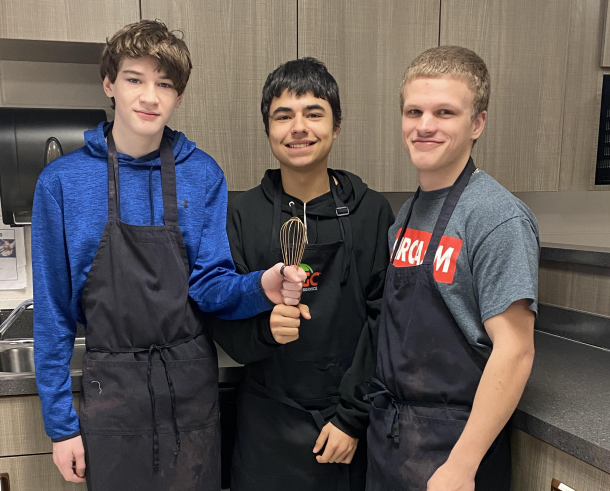
Kameron Steeley, Erik Jones and Dakota Crase hold up the Golden Whisk Award, which they currently hold for winning the School Lunch Chopped Competition. (Photo submitted)
School Lunch Chopped competition gives students insight into school lunch preparation
Every school day, students at public schools across the United States eat breakfasts and lunches made by their schools’ food staff. But as they eat these meals, how many of them give any thought into the effort the cooks put into preparing them? A two-month project completed by Ash Grove students in the Advanced Foods course, taught by FACS Instructor Jocelyn Lowry, gave the kids taking the class some insights into the everyday challenges school cooks face when preparing meals at school.
Students prepared meals using same guidelines followed by school cooks
The project, called the School Lunch Chopped Competition, required the students to form teams where the members worked together to create a meal using only certain ingredients provided to them, while they also worked within the same guidelines the school food staff are required to adhere to in meal preparation. The project concluded with the teams presenting their creations to a panel of judges, including a former student and competition winner, a school board member, a professional chef and school teachers.
The winning entry, created by students Erik Jones, 18, Dakota Crase, 17, and Kameron Steeley, 15, was a braised pulled-pork sandwich with basil berry sauce, topped with provolone cheese and served with a side of black bean and mango salad.
Kameron said that each team was given a “mystery basket” and had to create a meal using everything it contained.
“We were given a mystery basket, and it contained a bunch of different foods that we had to choose all of, and we could choose an envelope that gave us extra items,” he said.
“We had pork, grain, which was in the … mango salad, dairy, berries, seasoning, vegetables and legumes,” said Dakota, adding that their envelope also gave them rice and mango.
Dakota also explained the restrictions put on the teams during the project, while also noting the amount of research it took to find a meal that would fit within the school lunch guidelines.
“We had to go through the regulations of the school system’s lunch program,” he said, “because they can’t serve certain things to kids, and they have certain requirements to meet for nutrition. So, we had to make sure we had the dairy, the protein, all of the nutritional requirements before we could move on. And a lot of the recipes we came up with at first didn’t have anything like that. They didn’t meet requirements.”
Teams also had to consider pricing when planning meals
Among the requirements for the meals was that each had to cost $2 per student. Kameron said it was one of many factors they considered when planning the meals.
“We were like having to think of price for every student,” he said, “as well as how much calories for each student, and how much we would need for each student, so we knew that we would have to combine it together in 100 servings, and we would have to find out how many measurements are for each serving.”
White said competition gives students insights into challenges cooks face
Rita White, food services director, said the competition helps promote understanding between students and her cooks, as it allows the students insights into the regulations cooks are required to follow when fixing meals.
“It's important for me to have the kids know what my cooks are able to do, and what they're not able to do, like salts and fats and sugars and stuff,” she said. “This way they learn that, because they have to go by our guidelines.”
This was the first time the School Lunch Chopped Competition had been held at Ash Grove since the 2017-18 school year; Lowry said the pandemic had interrupted further competition until now. However,
White said that based on her experiences with the last competition, the 10 students who took part in this year’s challenge would let the other students know about the restrictions the cooks have to deal with.
“These kids will talk to the other kids in the school,” she said. “You know, I've heard them when the first (competition) went around. Somebody (would) make a comment like ‘Well I would like to have more salt on this.’ And yeah you'd hear one of the students speak up and say, ‘Well, you know, they have their limitations just like we did in our shop.’ So it really does get it out there, why we can't do certain things and why we do certain things … and where our foods come from and all that.”
Students also learn life skills
Lowry said the students also gained several valuable skills through the competition.
“They learned safety and sanitation practices, internal cooking temperatures of different meats and foods, (and) how to prepare them safely,” she said. “(They also learned) time management; they only had a certain amount of time available prior to competition to make sure their food was hot and fresh. Everyone who comes out of this class is going away with lifelong skills that they will be able to use every day of their life even just from this competition.”
Food can be made in different ways
Erik, Dakota and Kameron also said they gained some valuable insights from the competition. Dakota said he was surprised at how good the pulled pork/basil berry sauce combination actually tasted.
“I didn’t really consider the berry basil sauce to be a good option,” he said. “I didn’t think it would taste good on pork, until we made it, and we tried it. Because berries and pork aren’t a usual combination.”
Kameron said he had a similar concern.
“I had never thought to put fruit with meat, because it’s like the weirdest combination I could ever think of,” he said. “I had never heard of that, seen that, until now.”
For his part, Erik said he felt the team worked better together than he was expecting.
“Something that surprised me was how me and my group communicated so well when we were challenged with our basket ingredients,” he said.
For winning the challenge, the meal that Dakota, Erik and Kameron created will be served to the Ash Grove High School student body for lunch on Wednesday, Feb. 15. They were also given the Golden Wisk, a kind of traveling trophy between the students in the Advanced Foods Class which is given to a team of students when they win a competition or demonstrate some other achievement, and they got to assist Chef Curtis Adams during a field trip to SGC Foods, as he prepared various renditions of their winning entry.
In their future careers, Dakota would like to be an arborist, Kameron would like to be a chef, and Erik hopes to go to college in Philadelphia to study health sciences.
Category:
Lawrence County Record
312 S. Hickory St.
Mt. Vernon, MO, 65712
www.lawrencecountyrecord.com
