
Republic SRO’s prepare for shooting scenario
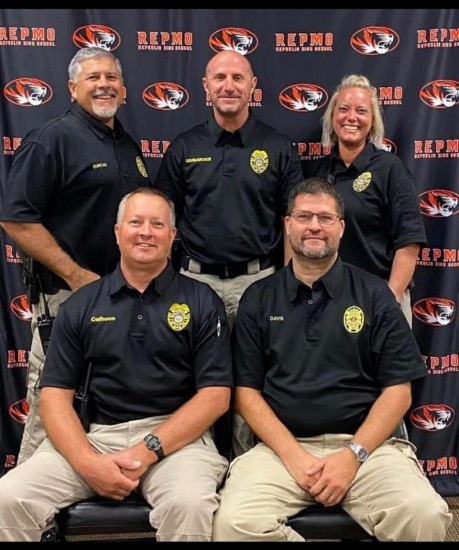
Shown are the five Republic School Resource Officers who conducted active shooter training earlier this month. Shown in the front row, are Jim Calhoon, Jon Davis; in the back are Robert Duncan, Scott Umbarger and Katie Hough. (Photo submitted)
On May 24 of this year, in Uvalde, Texas, 18-year-old Salvador Ramos shot his grandmother in the face after they got into an argument about his failure to graduate from high school (she was wounded, but survived). Then Ramos went to Robb Elementary School with an AR-15 rifle, where he killed 19 students and two teachers before he was himself killed by border patrol officers.
Since then, Uvalde police officers who initially responded to the scene have faced a wave of criticism, specifically regarding the amount of time it took for them to respond to Ramos, who was in the school for about an hour and 20 minutes before any law enforcement officers entered the building.
To prevent a similar tragedy from happening at any of the schools in the Republic R-III District, the Republic School Resource Officers (SROs) and officers with the Republic Police Department began a two-week training exercise on July 11, where they simulated active shooting scenarios to prepare for the possibility of an active shooter on a school campus.
SROs train to minimize casualties
Scott Umbarger, the district’s director of safety and security, said the officers were training to help them prevent casualties during an active shooter situation.
“The purpose of conducting training of this nature is to prevent or minimize the loss of life in any mass casualty incident,” he said. “It also allows members of the Republic School District and the Republic Police Department to train together. This allows us to respond quicker and more efficiently in the event of an emergency.”
Citing security concerns, Umbarger declined to discuss the specific procedures the SROs would follow should an active shooter situation occur but said that if an armed person were to come onto campus, they would attempt to contact the shooter about their reasons for being there with a firearm.
“In general, we would contact the person outside the school and determine what they are doing near a school with a weapon,” he said. “We would implement internal procedures to prioritize the safety of our students and staff.”
SROs, Republic Police work together to protect students
Should an active shooter come onto a campus, Umbarger said the SROs would be the school’s first line of defense, with assistance from the Republic police force.
“The Republic School District School Resource Officers will more than likely be the first law enforcement officers to contact the suspect,” he said. “We train to engage the suspect/s individually and in teams of two, three and four officers. Depending on the situation, Republic Police officers will arrive and assist engaging the suspect or begin providing care to the injured or evacuating students and staff.”
Umbarger also said that, in an active shooter situation, the overriding concern is to protect the lives of everyone on campus.
“All of our decisions and actions are based on the safety of our staff and students, and our safety priorities,” he said. “The first priority is to end the active loss of life. Once the suspect is no longer a threat, we begin caring for the injured and begin evacuations.”
Preparing for the unknown
While the SROs prepare for every active shooter situation they can, Umbarger said there are also a lot of unknowns in every situation which require the officers to, as the saying goes, expect the unexpected.
“It is very difficult to simulate the extreme chaos in a mass casualty incident,” he said. “It is hard to replicate the number of staff and students in a building, the victims and the confusion. It is also impossible to replicate being shot at and moving through the gunfire to deal with the suspect. With that said, we do our best to simulate everything we can to make our training as realistic as possible. We study what happens in other mass casualty incidents to make sure we have plans in place in case similar incidents happen here. We update our plans and procedures accordingly and train for anything we may have not trained for in the past.”
Prevention a key component in student safety
While the officers trained for the possibility that they might encounter an active shooter, Umbarger said his department also believes in the importance of preventing shootings by building relationships and rapport with students.
“Prevention begins with building relationships with staff and especially students,” he said. “Students need to have a connection with at least one staff member that they feel comfortable talking to. Mental health is a big part of prevention, so we are able to recognize when a student is struggling and get them in contact with a counselor.”
Umbarger also said his SROs work closely with other staff members in the district to help students who may be in need of support.
“Collaboration between administrators, counselors, staff and SROs is vital,” he said. “No one person or department can be responsible for everything. We meet frequently with team members from every department and discuss students that may be struggling and develop strategies to help support them.”
Finally, Umbarger said, every campus is designed to keep any person who might pose a danger to students from entering the building.
“Physical preventive measures are also important,” he said. “All of our schools have secure vestibules, and we operate in a lock-out status during the school day. All other doors are locked at all times during the school day. All guests check in at the front office before entering the building.”
More info
Any questions regarding student safety on campus or any other concern can be directed to Nikki Faith, district communication specialist, by e-mail at nikki.faith@republicschools.org.
Category:
Lawrence County Record
312 S. Hickory St.
Mt. Vernon, MO, 65712
www.lawrencecountyrecord.com
